RL-Checkers
Checkers simulation, policies, game logging and reinforcement-learning experiments.
The idea
A learning project about turning a familiar board game into an environment for experimenting with decisions. Instead of starting with a black-box learning library, the repository builds the board, legal moves, captures, rewards, policies and trajectory records in Python. The user confirms that learning new tools and techniques was the common motivation across these projects. Here the source supports game simulation, search, reinforcement-learning experiments and numerical data handling as the relevant learning areas. It does not establish a trained agent's strength or convergence.
How it works
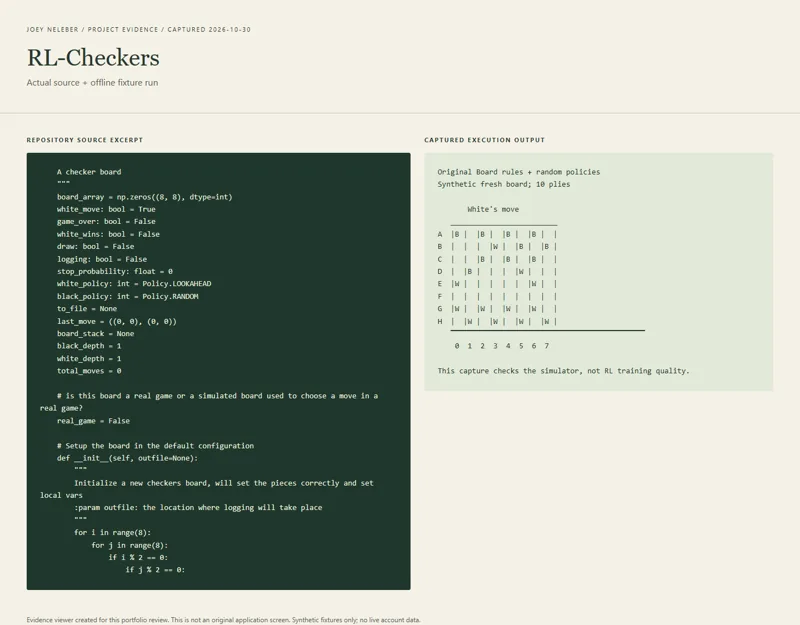
Create a fresh Board and choose policies for the white and black players through PolicyEnum.
Ask the board for legal actions and advance turns through play; compare random, lookahead and rollout approaches where implemented.
Inspect terminal board output and recorded state transitions; use trajectory files as inputs to the LSTD exploration.
Treat the separate policy_gradient.py as unfinished working material rather than a runnable entry point.
Inside the build
Rules before learning
The Board class represents the board as a NumPy array and implements move generation, secondary captures, rewards and endgame handling. That gives the learning experiments an explicit environment rather than hiding the game's mechanics.
Trajectory logging as a data structure problem
Joey's commits implement a linked-list board history and write state, move and reward information to TSV. Capturing the right transitions is an engineering step of its own: a learner cannot recover information the simulator never recorded.
Multiple decision strategies
PolicyEnum and main.py expose random, lookahead, rollouts, LSTD and policy-gradient paths. The separate training scripts and incomplete scratch file show experimentation at different levels of completeness, not one uniformly finished algorithm suite.
What I learned
Knowing what a demonstration proves
A simulator producing legal-looking states is different from an RL policy learning well. The incomplete standalone policy-gradient file stays part of the story because it records the boundary between an idea, an experiment and an implementation.