Airbnb Defuzz
Match listing signals to candidate public property records.
The idea
Airbnb Defuzz explores uncertain record matching through a small browser extension and a local Python service. The project goal was to take listing signals with approximate coordinates and produce ranked property candidates from public records. The learning thread is extracting imperfect browser data, combining weak signals and showing uncertainty to a person. That is more specific—and more honest—than calling it a tool that always discovers an exact identity.
How it works
Open a listing page and use the extension. Its content/background path extracts coordinates and optional details such as bedrooms, bathrooms, host-name signals and amenities.
Send the extracted signals to the local resolve endpoint, where geographic lookup supplies candidate records. This pass replaces the real lookup with invented records.
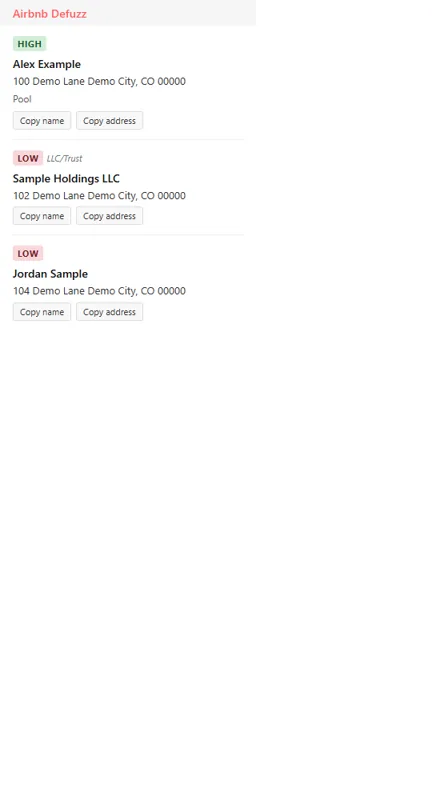
Inspect candidate cards, their confidence and missing-field hints. Confidence is an application heuristic, not independently measured identification accuracy.
Use copy actions only when appropriate to the actual workflow. No real listing, owner contact information, geocoding request or property database was accessed in this demonstration.
Inside the build
Browser extraction across a service boundary
The extension has to distinguish unavailable coordinates from merely missing optional fields. The popup then carries that partial result through a local API call instead of treating every missing value as an unrecoverable failure.
Pure scoring logic
server/scorer.py keeps matching separate from database and network I/O. That made it possible to execute the real scoring function on synthetic records and reuse its output in the actual popup UI.
Confidence and ambiguity
Bedroom, bathroom, name and pool signals contribute different evidence. Cluster detection and hints acknowledge that multiple candidates can remain plausible, especially when the location is approximate.
A testable popup
The capture uses the original popup markup and JavaScript. A fixture substitutes the Chrome messaging API and local resolve response; the scored records themselves come from executing the real Python scorer.
What I learned
Represent uncertainty explicitly
This project provides a way to discuss ranking, missing evidence, name ambiguity and the difference between a high heuristic score and a verified match.
Keep the core independently runnable
Separating a pure scorer from the Flask/database path makes the behavior easier to inspect and reproduce. Browser UI problems and scoring problems can then be investigated separately.