Earlier SPAITR desktop collection app
Collect BLE sensor sessions and annotate/extract lacrosse shots.
The idea
Build a desktop bridge between physical training sensors and useful experiments: manage several BLE devices, collect sessions, annotate/extract shots and display predictions. The code makes Bluetooth, asynchronous GUI programming, data preparation and model integration source-supported exploration topics; personal learning outcomes and model accuracy remain undocumented.

How it works
The intended desktop entry point opens the SPAITR Analytics Dashboard, with per-device slots and a Discover Devices control.
Discovery displays available BLE devices; selecting a device associates a BluetoothDevice and a session widget.
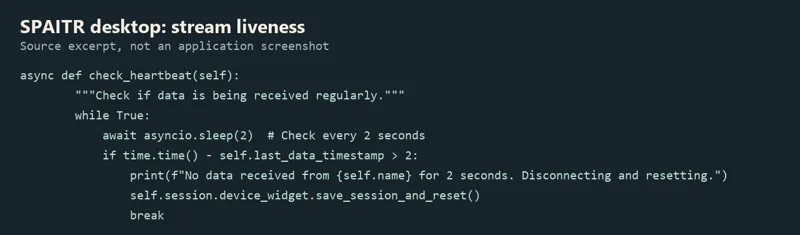
The collection flow receives accelerometer/gyroscope/magnetometer streams and associates them with session work. A heartbeat detects a stream that has stopped and requests save/reset.
Model artifacts are loaded for angle and speed prediction. Collection, annotation/extraction and analysis are related stages, but no prediction quality or live sensor run was verified here.
Inside the build
PyQt6 with asyncio
PyQt6 widgets form the multi-device dashboard and discovery dialog; qasync integrates async actions into the GUI.
Bluetooth device lifecycle
Bleak supplies the client/discovery integration. BluetoothDevice tracks last-data time and handles stream liveness, connection and disconnection.
Data and model tooling
NumPy/pandas and scikit-learn dependencies accompany shot extraction and joblib model loading. Loading a pre-trained artifact is visible in main_window.py, but provenance and accuracy were not established.
What I learned
Async work inside a GUI
Source-supported topic: keeping device discovery and connection lifecycle separate from widgets while handling multiple sessions.
Make collection usable
Commit evidence supports solo collection, save/reset fixes and sound cues. These are practical tool-building changes around the experiment, not just a machine-learning headline.
Know the model boundary
The repository integrates angle/speed model files, but this research did not run untrusted pickle artifacts, inspect training records or establish evaluation results. The portfolio should discuss the pipeline without inventing accuracy.