flipper
Craigslist scraping with a Flutter frontend and Flask endpoints.
The idea
A useful example of a learning exercise finding a second context. The Craigslist scraper explicitly started as an IT 630 assignment: collect online data and convert it to CSV. It later appears inside a team prototype named flipper with a Flutter frontend and Flask endpoints. The source supports learning how messy website markup becomes structured records, then exploring how those records might sit behind an application. It does not support calling flipper a completed resale platform, a working arbitrage engine or a launched business.
How it works
The scraper's original terminal workflow lets a user narrow a Craigslist location/category/search, parse listing pages and write listing records to CSV.
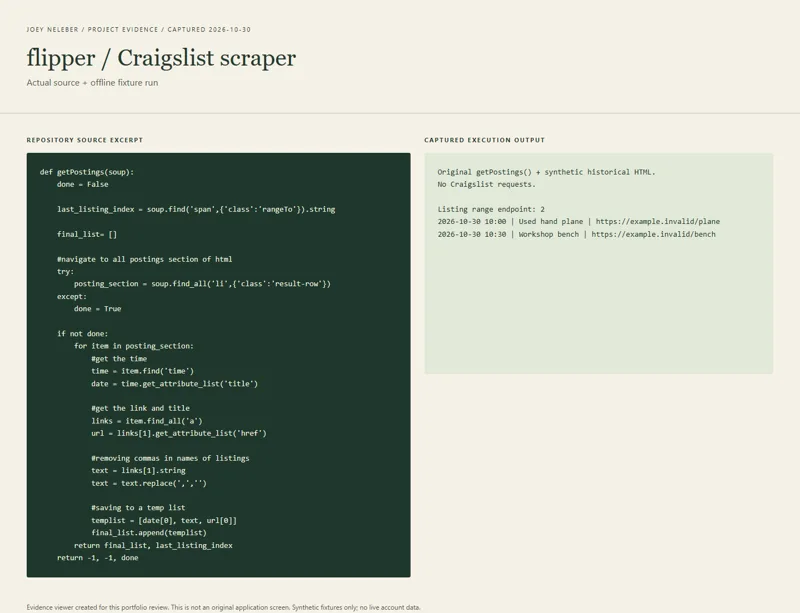
getPostings extracts a title, timestamp and URL from the historical result-row markup.
The portfolio fixture feeds that original parser two synthetic historical-style listings; it makes no live Craigslist requests.
The Flask project contains product-related route placeholders, while the Flutter frontend is team work. Those surfaces were not validated as an integrated application.
Inside the build
DOM parsing and data cleanup
BeautifulSoup locates result rows, reads time attributes and listing links, and removes commas from titles before CSV output. The implementation shows the practical mechanics of extracting structured rows from a website.
Request and paging logic
urllib builds location/search URLs, and the script includes paged fetching with delays. These reflect the historical site structure and were not treated as a current, robust scraping API during the review.
A prototype across languages
The repository combines Python parsing and Flask with a Flutter client. The getProducts/getFlipper handlers still return empty jsonify placeholders; having the folders does not establish a complete data flow.
What I learned
Turning unstructured input into something reusable
The concrete learning area is the boundary from HTML to records: selecting useful fields, normalizing strings, handling page ranges and deciding what a CSV row should contain. The offline parser run proves that small boundary against a controlled fixture.
Reusing a technique without overstating the result
The coursework header and later scraper commit provide a real progression from assignment to prototype component. They also identify what Joey actually contributed, keeping the team frontend and incomplete backend integration separate.