gCalFunctionality
Read calendar events with the Google Calendar API.
The idea
A compact API-integration learning exercise: start from a Calendar quickstart-style authorization/client setup, then inspect owned calendars and find a first event across them. The point is the technique rather than the scale. It introduces the chain from permission scopes and an API client to paginated-looking response objects, event timestamps and a small selection rule. The user confirmed that jan1024 was their college Git identity, so that commit name is attributed to Joey rather than incorrectly treated as an unrelated author.
How it works
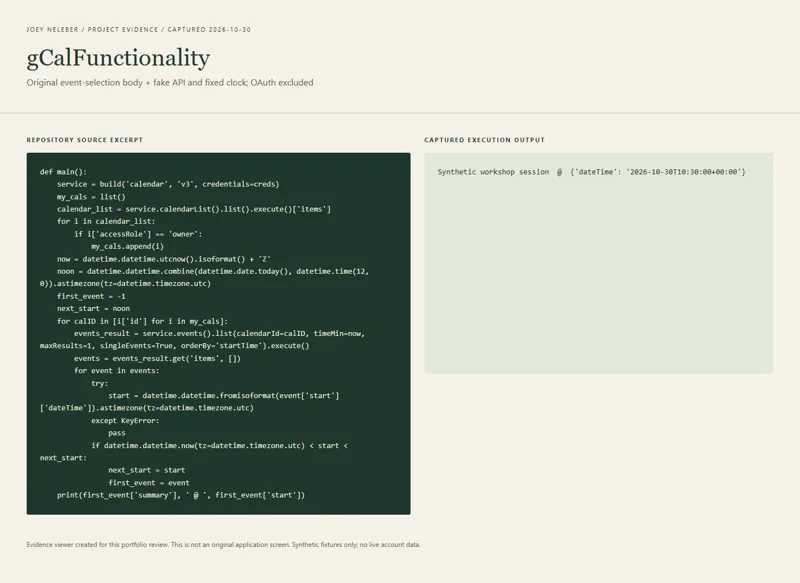
The original script requests read-only Calendar access through a desktop OAuth flow and constructs a Calendar v3 client.
It lists calendars, keeps calendars owned by the signed-in user, then requests the next event from each candidate calendar.
A timestamp comparison selects an event and prints its summary/start information.
Inside the build
OAuth scope and client initialization
The script uses Google's API client and installed-app OAuth helper with calendar.readonly. That is the scaffolding of a standard API quickstart; it is explicitly presented as such rather than an original authentication system.
Filtering and aggregation
The custom workflow filters calendars by owner role, gets one next event for each and compares parsed start times. Python dictionaries, list comprehension and datetime handling perform the selection.
Time is part of correctness
Source compares current UTC time, timezone-normalized start values and a local-noon cutoff. All-day events and no-matching-event conditions need more careful handling than the preserved script provides. The historical commit claim is therefore not copied into a stronger product claim.
What I learned
From a quickstart to a task
The source supports learning how to move beyond a sample API call: combine calendar metadata and event data into a useful selection.
Finishing the edge cases
The preserved code is an exploration, not a resilient calendar assistant. It can leave first_event as a sentinel and assumes a usable timed event after an all-day-event branch. Those boundaries explain the last state without erasing the useful API learning.