Navier–Stokes numerical lab
Explore model equations, fluid simulation and dual-geometry diagnostics.
The idea
This is a numerical notebook turned into a small Python laboratory. The aspiration was to explore model equations and fluid/gravity connections through code, starting with cases whose behavior can be checked. The planning documents are ambitious, but the portfolio framing is deliberately practical: implement solvers, compare to known answers, plot diagnostics and report limitations. Learning the numerical techniques is the story; this is not a claim to have solved Navier–Stokes regularity or established a new physics result.
How it works
Choose an experiment stream: simplified singularity models, large-dimensional effective equations or fluid-to-geometry diagnostics.
Set an initial condition and numerical resolution, run the solver and inspect a plot or diagnostic rather than relying on a final scalar alone.
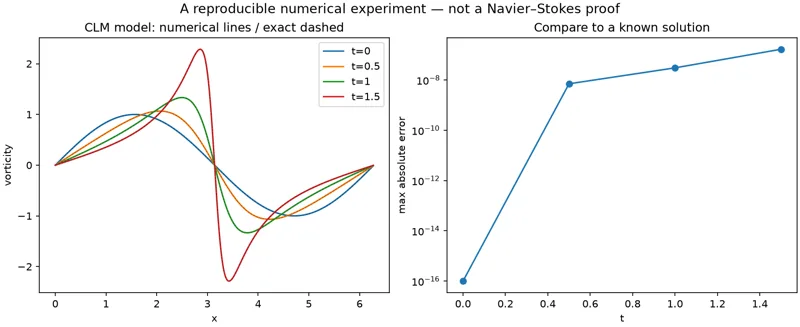
Where an exact solution exists, compare against it. The reproduced experiment runs the actual CLM integrator on a sine initial condition and plots it beside the exact formula.
Vary resolution or parameters and look for numerical artifacts before interpreting a sharp feature as physical behavior. This pass demonstrates one comparison, not the entire research program.
Inside the build
Spectral methods
The source uses periodic grids and Fourier-based operations. Spectral differentiation and Hilbert transforms provide compact implementations, but resolution and aliasing remain part of the experiment.
Adaptive stepping around strong signals
The CLM integrator scales its time step with the amplitude and advances with RK4. A known exact solution makes it possible to check the implementation rather than interpreting every output as a discovery.
Multiple experiment streams
The repository separates model equations, large-D systems and BKLS diagnostics. That modularity is useful because a success in a simplified model is not automatically a statement about the full fluid equations.
Reproducible plots
The included PNG was generated from the original committed solver at 512 periodic samples and specified times. It is a new local result of that fixture, not a historical experimental figure or a peer-reviewed finding.
What I learned
Numerics need a reference
Exact-solution comparisons give a practical route into error, resolution and time-stepping questions. A convincing plot is a starting point for checking a computation, not a substitute for those checks.
Separate ambition from result
The original idea connects difficult research areas. The implemented and reproducible learning outcome is a collection of experiments and diagnostics; originality and scientific conclusions need substantially more validation.